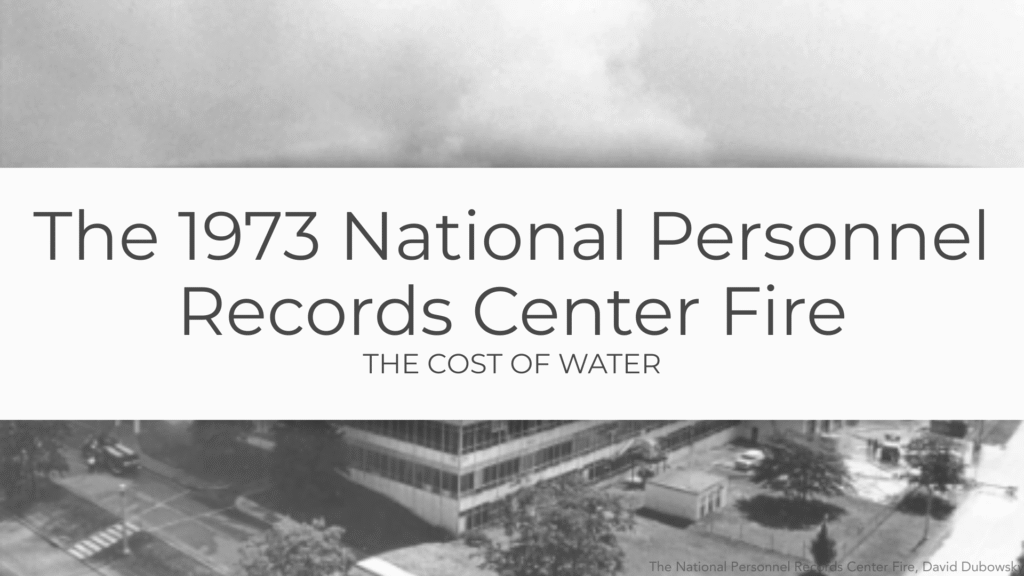
On July 12, 1973, a massive fire broke out at the National Personnel Records Center (NPRC) in St. Louis. While the flames were devastating, the millions of gallons of water used to extinguish the fire caused irreparable damage to military records. This event remains a primary case study for waterless suppression.
In environments that house sensitive data or irreplaceable archives, water is often as much of a threat as the fire itself. Modern clean agent systems are designed to extinguish fires without leaving any residue or causing liquid damage. This preserves the integrity of critical data and historical documents.
Quick Look: The Historical Impact
- Event: National Personnel Records Center Fire
- Date: July 12, 1973
- The Cause: Fire of unknown origin on the building’s sixth floor
- The Result: Destruction of 16-18 million military personnel records, with water damage from firefighting efforts causing additional irreparable harm
- Modern Lesson: Archives and data centers require clean agent suppression systems that eliminate fire without water-based collateral damage
The Devastating Scope of the Disaster
The fire at the NPRC began on the sixth floor of the overland storage facility and quickly spread through the building. Firefighters battled the blaze for more than 22 hours and pumped approximately two million gallons of water into the structure. This aggressive firefighting approach eventually controlled the flames. Unfortunately, it created a secondary disaster that would have lasting consequences for decades.
The facility housed military personnel service records dating from 1912 through 1964. These records represented millions of American veterans. The combined effects of fire, heat, smoke, and water destroyed an estimated 16 to 18 million official military personnel files. Among these were approximately 80% of Army personnel records for individuals discharged between 1912 and 1960, and 75% of Air Force records for personnel discharged between 1947 and 1964.
When Water Becomes the Enemy
What makes this fire particularly significant from a fire protection perspective? The water damage proved just as destructive as the flames themselves. Records that survived the initial fire were often rendered illegible or completely destroyed by the millions of gallons of water that saturated the building. Paper documents became waterlogged masses. Ink ran and smeared. Mold grew almost immediately in the humid conditions.
The water pooled on floors, dripped through ceilings, and created cascading damage throughout multiple levels of the facility. Even records stored in areas not directly affected by flames suffered water damage as firefighters worked to prevent the fire’s spread. This secondary damage transformed what might have been a recoverable situation into an irreversible loss of historical documentation.
The Human Cost of Lost Records
The impact of this disaster extended far beyond the physical building. Millions of veterans found themselves unable to prove their military service. This complicated applications for benefits, medical care, and employment opportunities. Families researching their military heritage discovered gaps that could never be filled. The federal government established an exhaustive reconstruction effort, but many records remain lost forever.
Veterans that needed documentation of their service faced bureaucratic challenges for years. Without official records to prove eligibility for VA benefits, it became difficult or impossible to establish service-connected disabilities or even confirm dates of service. The National Archives implemented alternative verification procedures. But these could not fully replace the lost primary documentation.
Fire Protection Lessons for Modern Facilities
The NPRC fire fundamentally changed how fire protection professionals approach facilities that house irreplaceable documents, sensitive electronics, and critical data. The disaster demonstrated that traditional water-based suppression systems, while effective at extinguishing flames, can cause catastrophic collateral damage in certain environments.
This realization accelerated the development and adoption of clean agent fire suppression systems. These modern systems use gaseous agents that extinguish fires through heat absorption and oxygen displacement without leaving residue or causing water damage. Advanced fire suppression fluids like those offered by Standard Fluids now provide certified alternatives that protect irreplaceable assets while eliminating fire risks.
Protect What Cannot Be Replaced
Today’s data centers, archives, museums, libraries, and research facilities benefit from the lessons learned at the NPRC. Clean agent systems provide rapid fire suppression without the destructive side effects of water. Standard Fluids’ SF 1230™ Fire Protection Fluid represents the type of high-performance solution specifically engineered for environments where the contents are as valuable—or more valuable—than the structure itself.
These engineered fluids are designed to suppress fires in seconds and leave documents, electronic equipment, and other sensitive materials completely undamaged. Unlike water-based systems that would have compounded the disaster at the NPRC, modern clean agents evaporate quickly without residue. This ensures that archives remain intact even during a fire emergency.
Modern fire protection design for archival facilities includes early detection systems, compartmentalization strategies, and suppression technologies that prioritize preservation alongside safety. The goal is to extinguish fires in a manner that protects irreplaceable materials from both flames and firefighting agents.
The Evolution of Fire Protection Standards
The chemical fluids industry has evolved significantly since 1973. Today, companies like Standard Fluids manufacture ISO 9001-certified fire suppression solutions that meet the most stringent international requirements. These products undergo rigorous third-party validation to ensure quality and purity for every batch produced and deliver the reliability that critical facilities require.
For facilities housing government records, historical archives, research data, and sensitive electronics, the choice of fire protection system carries profound implications. The NPRC disaster proved that the suppression method matters just as much as suppression speed. Water may extinguish flames, but in doing so, it can destroy exactly what firefighters are trying to save.
The 1973 NPRC fire serves as a permanent reminder that effective fire protection must consider the entire lifecycle of a fire event. This includes the potential damage caused by suppression efforts themselves. Today’s clean agent technologies ensure that protection and preservation work together, not against each other.
Learn about Standard Fluids clean agent fire suppression: https://standardfluids.com/contact/.