

[H1] SF 7500™ Engineered Fluid: The 3M™ Novec™ 7500 Replacement
Standard Fluids™ SF 7500™ Engineered Fluid is an isomeric drop-in replacement for 3M™ Novec™ 7500, produced today by the team that developed the original Novec™ product line. SF 7500 Fluid has the same HFE-7500 chemistry and CAS number as the original, which simplifies qualification and minimizes process-change requirements when transitioning from Novec™ 7500.
- SF 7500™ Engineered Fluid
A Direct Replacement for 3M™ Novec™ 7500 - Same HFE-7500 chemistry. Same CAS number. USA verified quality and performance.
- SF 7500™ is a high-purity hydrofluoroether engineered for semiconductor thermal management, electronic cooling, reliability testing, and demanding industrial heat-transfer applications.
- CAS 297730-93-9 | 128°C boiling point | -100°C freezing point | Non-flammable | VOC-exempt
SF 7500™ Engineered Fluid vs. Novec™ 7500
| Property | NovecTM 7500 | SF 7500TM |
|---|---|---|
| Chemical name | 3-Ethoxyperfluoro(2-methylhexane) | 3-Ethoxyperfluoro(2-methylhexane) |
| CAS number | 297730-93-9 | 297730-93-9 |
| Molecular weight | 414.1 g/mol | 414.1 g/mol |
| Boiling point | 128°C | 128°C |
| Freezing point | -100°C | -100°C |
| Liquid density at 25°C | 1.614 g/mL | 1.614 g/mL |
| Kinematic viscosity | 0.8 cSt | 0.8 cSt |
| Dielectric strength, liquid at 25°C | 35 kV | 35 kV |
| GWP | 13 | 13 |
| ODP | 0 | 0 |
How SF 7500™ Engineered Fluid Transfers Heat
Like other single-phase dielectric coolants, SF 7500 fluid moves heat by direct contact, not through a heat sink or cold plate. Here’s how that happens in a typical closed-loop cooling system:

1. Immersion or Contact
Hardware sits either fully submerged in an immersion tank or routed through direct-contact cold rails bonded to high-power components like ASICs or CPUs. Immersion tanks carry a lid or vapor barrier to limit evaporative loss, since the fluid generates some vapor pressure even below its boiling point. Connectors and components in contact with the fluid need to be rated for it; not every off-the-shelf part qualifies. Tank and rack designs are commonly built to the Open Compute Project's immersion cooling specification.

2. Circulation
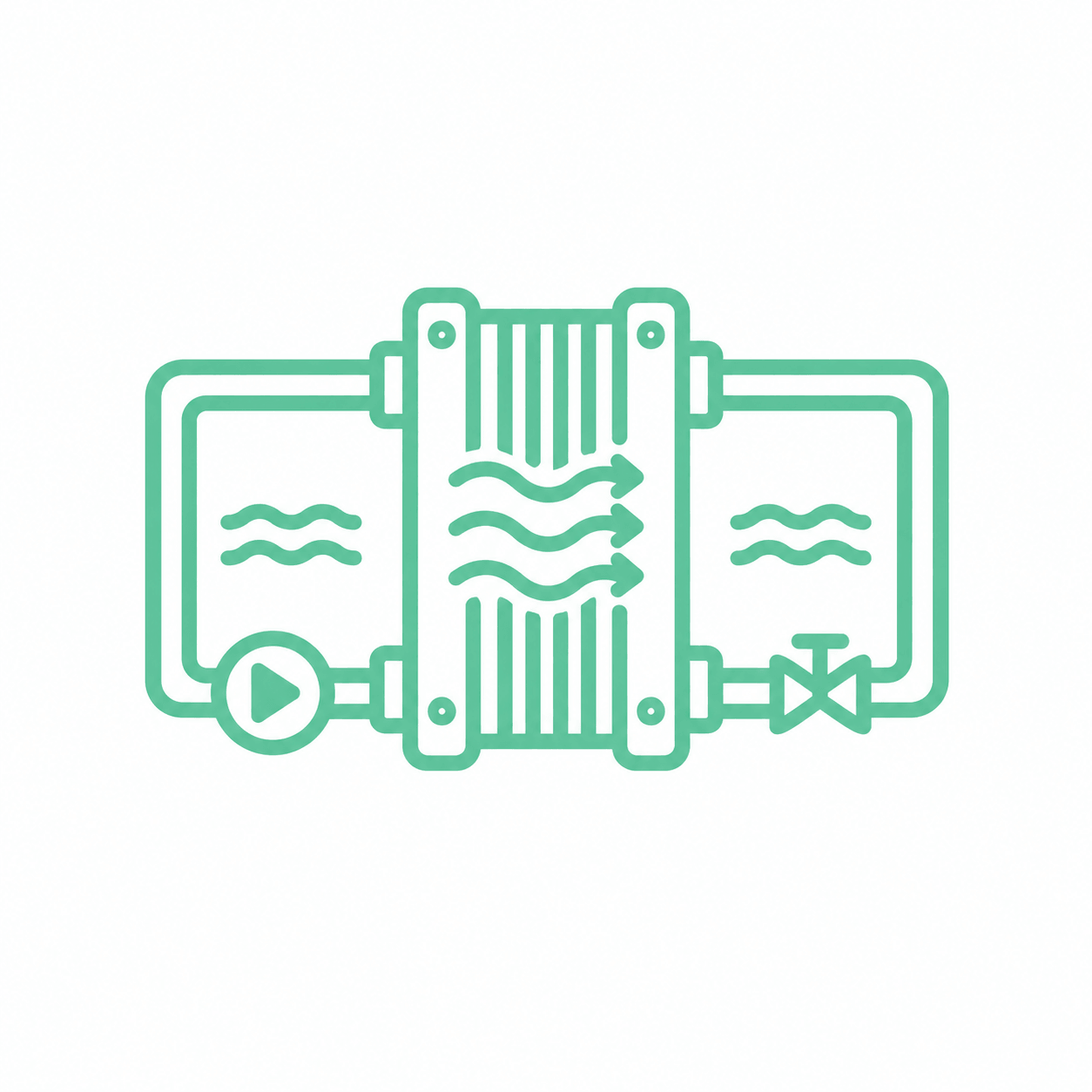
A pump drives the fluid through the loop, sized to the rack's actual heat load, and routes it through an inline filter that strips particulates before they foul pump seals or coat heat exchanger surfaces. Lower-density racks sometimes skip the pump entirely, relying on passive convection, the fluid's own density difference between hot and cool zones.
3. Rejection
The heated fluid reaches a coolant distribution unit, where a brazed plate heat exchanger separates the dielectric loop from a secondary facility water loop. The two fluids never mix, so facility water treatment stays independent of the coolant. A control valve on the secondary side holds the fluid at its target return temperature, within the ASHRAE W-series classes that define acceptable facility water supply temperatures.

4. Return
Temperature and flow sensors at the CDU feed that control loop. In multi-rack deployments, a manifold splits the cooled fluid across parallel circuits before it re-enters the immersion tanks or cold rails.
The Same Testing Standard, Batch After Batch
Every shipment of Standard Fluids™ SF 7500™ Engineered Fluid includes a batch specific Certificate of Analysis from an independent third-party laboratory, manufactured under an ISO 9001-certified framework.
That testing methodology sets the quality standard across the entire Novec™ and HFE category: four parameters that determine whether a fluorochemical actually performs to spec. Each batch of SF 7500 fluid is verified against the original HFE-7500 specification before it ships, including:
- Purity: confirms the batch matches the HFE-7500 molecular specification
- Acidity: confirms free acid content stays low enough that it won’t corrode pumps, coolant distribution units, or piping
- Water content: confirms dissolved moisture stays within spec, since excess water affects dielectric strength
- Stability: confirms the fluid holds its properties under extended thermal cycling, across its full operating range
Where SF 7500™ Fluid Is Used
SF 7500 fluid is specified wherever a system needs dielectric stability across extreme heat densities or temperature swings. That includes semiconductor fabs, reliability labs, and immersion cooling installations that used to run on legacy PFC and PFPE fluids.
Semiconductor
Ion implanters, dry etchers, and CVD/PVD tools generate heat densities that demand a fluid stable enough for direct contact with energized components, cycle after cycle, without breaking down.
Immersion Cooling
Supercomputers, data centers, and power electronics rely on a dielectric fluid built for single- or two-phase configurations, holding up through years of continuous contact with energized hardware.
Reliability Testing
Thermal shock and hermetic seal testing cycle components between extreme temperatures, conditions the test fluid itself has to survive as reliably as the hardware being tested.
Solvent Cleaning
Circuit boards collect flux, oils, and particulates during manufacturing. SF 7500 fluid reaches where other solvents can't, and it carries thin lubricant films onto small parts without leaving residue behind.
SF 7500™ Fluid Frequently Asked Questions
What is SF 7500™ Fluid?
What is a hydrofluoroether?
A hydrofluoroether, or HFE, pairs a fully fluorinated carbon chain with a non-fluorinated end group, linked through ether oxygen. The fluorinated chain gives SF 7500 fluid the dielectric stability and chemical inertness legacy PFCs are known for, since fully fluorinated bonds resist breaking down under normal conditions. The non-fluorinated end group changes that. It gives atmospheric hydroxyl radicals a bond they can react with, so the molecule breaks down in the atmosphere instead of persisting like a fully fluorinated PFC.
Why does SF 7500™ Fluid have such a wide liquid operating range?
HFE molecules have weak intermolecular forces and no hydrogen bonding like water, which keeps the freezing point low, down to -100°C. SF 7500 fluid’s larger molecular structure compared to lighter HFE fluids like SF 7100 pushes the boiling point up to 128°C, wider on the high end than most engineered fluids in this class.
Is SF 7500™ Engineered Fluid safe to use around energized equipment?
What certifications and regulatory status does SF 7500™ Fluid hold?
SF 7500 fluid is VOC-exempt and EPA SNAP-accepted as a substitute for legacy PFCs and PFPEs.
Is SF 7500™ Engineered Fluid a PFAS?
By chemical definition, yes. Hydrofluoroethers contain carbon-fluorine bonds, which form the basis of the classification. SF 7500 fluid’s carbon-hydrogen bond gives atmospheric hydroxyl radicals a site to break the molecule down, with an atmospheric lifetime around 2.2 years, rather than persisting the way legacy PFCs and PFPEs do.
Want to go deeper on PFAS classification?
Download our fluorochemist’s guide to what PFAS actually means →
Why did the industry move from PFCs and PFPEs to hydrofluoroethers like SF 7500™ Fluid?
Legacy perfluorocarbon (PFC) and perfluoropolyether (PFPE) fluids, like 3M’s own Fluorinert™ line, delivered the dielectric stability and chemical inertness semiconductor and military cooling needed, but their fully fluorinated structure gave them atmospheric lifetimes running into the thousands of years and GWPs as high as 6,000 to 10,000.
Hydrofluoroethers kept that performance while adding a carbon-hydrogen bond that lets the molecule break down in the atmosphere instead of persisting, cutting GWP by more than 99%.
How does SF 7500™ Engineered Fluid compare to SF 7300™ Engineered Fluid for heat transfer applications?
SF 7300TM Engineered Fluid runs at a 98°C boiling point, suited to stable, moderate-temperature thermal loops. SF 7500 fluid’s 128°C boiling point supports applications that SF 7300 fluid can’t handle, including semiconductor process heat and reliability testing that pushes hardware past what a 98°C fluid can absorb without boiling off.
How should SF 7500™ Fluid be stored and disposed of?
Store it in a clean, dry area away from heat sources and incompatible materials. Standard Fluids’ used fluid return program handles disposal through independent, third-party-audited treatment facilities.
Is SF 7500™ Engineered Fluid a drop-in replacement for Novec™ 7500? Does my process need revalidation?
SF 7500 fluid is molecularly identical to Novec™ 7500 under the same CAS number, with matching boiling point, viscosity, and dielectric strength. Full revalidation usually isn’t necessary, but Standard Fluids actively supports the many customers who choose to requalify their systems when specifying SF 7500 fluid. Please contact us for technical support.
How can I get started with SF 7500™ Fluid?
Contact the Standard Fluids team directly. We’ll confirm availability, provide technical documentation, and walk through distributor and pricing information for your application.
