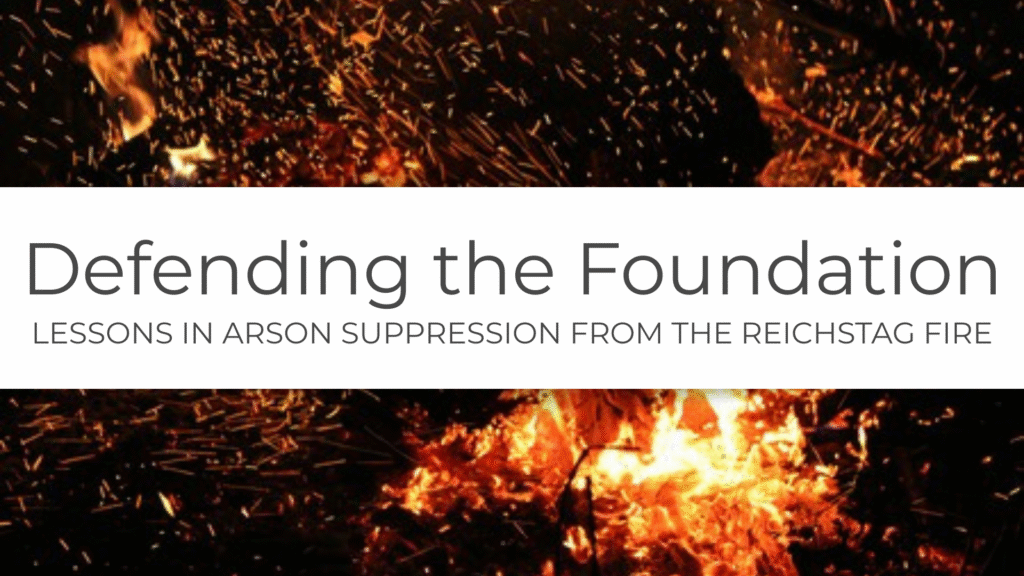
History rarely provides a more chilling example of the intersection between infrastructure and political instability than the 1933 Reichstag Fire. On the night of February 27, the heart of the German Parliament was engulfed in flames, an event widely attributed to arson and immediately leveraged as a catalyst for sweeping legislative changes. While the historical debate over the perpetrator continues, the technical reality remains: a single point of failure allowed a fire to alter the course of a nation.
For modern facility managers and security experts, this Fire Friday reminds us that fire safety is also about sabotage protection and ensuring critical infrastructure safety.
Quick Look: The Historical Impact
Event: The Reichstag Fire
Date: February 27, 1933
The Cause: Multi-point arson combined with a lack of automated suppression
The Result: A catalyst for political upheaval and the suspension of civil liberties in Germany
Modern Lesson: Critical infrastructure requires sabotage protection and fire system redundancy to ensure the building defends itself when human intervention fails.
The Evolution of Arson Prevention
In 1933, fire suppression was largely reactive and relied on human detection and manual intervention. Today, we treat arson as a specific threat vector. Arsonists often attempt to disable safety measures before lighting a fire. In fact, this is a top reason why modern arson suppression strategies focus on making the system itself un-hackable.
Key components of a sabotage-resistant fire plan include:
- Tamper-Proof Detection: Modern sensors are equipped with anti-masking technology and internal alerts that trigger if a device is covered, moved, or disconnected.
- Encased Conduit: To prevent physical sabotage of wiring, critical signaling lines are often housed in heavy-duty, monitored conduits that trigger a “trouble” signal at the main panel if breached.
- Video Integration: Flame and smoke detection cameras provide real-time visual verification. This allows security teams to differentiate between a kitchen flare-up and a multi-point arson attempt.
Ensuring Fire System Redundancy
A system is only as strong as its weakest link. In high-stakes environments, fire system redundancy is the gold standard. If an intentional actor cuts a power line or shuts off a water valve, the system must have a “Plan B.”
Redundancy is achieved through a multi-layered approach:
- Independent Power Supplies: Secondary and tertiary power sources (typically battery backups and dedicated generators) ensure that the fire panel remains live even if the building’s primary grid is compromised.
- Distributed Intelligence: Rather than relying on a single “brain,” networked systems allow individual floor controllers to operate autonomously if the main control center is damaged.
- Secondary Suppression: For critical infrastructure, gravity-fed tanks or secondary pumps located in separate fire-rated zones ensure that sprinklers have water even if the primary main is shut down. In addition, modern fire suppression fluids like SF 1230™️ Fire Suppression Fluid offer protection beyond water capabilities.
Protecting Critical Infrastructure Today
From data centers to historic landmarks, the goal of Reichstag Fire arson suppression logic is to eliminate the human element of failure. If an individual intends to cause harm, the building must be smart enough to defend itself. This involves rigorous adherence to standards like NFPA 72, which outlines the National Fire Alarm and Signaling Code for maximum reliability.
Furthermore, integrating fire safety with physical security, such as biometric access to fire pump rooms, ensures that only authorized personnel can access the off switch.
Sabotage Protection
The Reichstag Fire serves as a historical warning that fire can be a weapon. However, with modern advancements in sabotage protection and system resilience, we ensure that our critical assets are built to survive. Regular audits and a commitment to redundant architecture are the best defenses against the unexpected and the intentional alike. Although we often think of fires as accidental, many of the world’s most critical infrastructure points are vulnerable to intentional acts of destruction.
Modern fire suppression systems are built with redundancies to ensure they react, even when the cause is malicious. From tamper-proof sensors to independent power supplies, these systems provide a silent, automated defense against arson. This ensures that vital landmarks and infrastructure remain protected regardless of the fire’s origin.
Schedule a consultancy with the Standard Fluids experts for an audit of your facility: https://standardfluids.com/consulting/