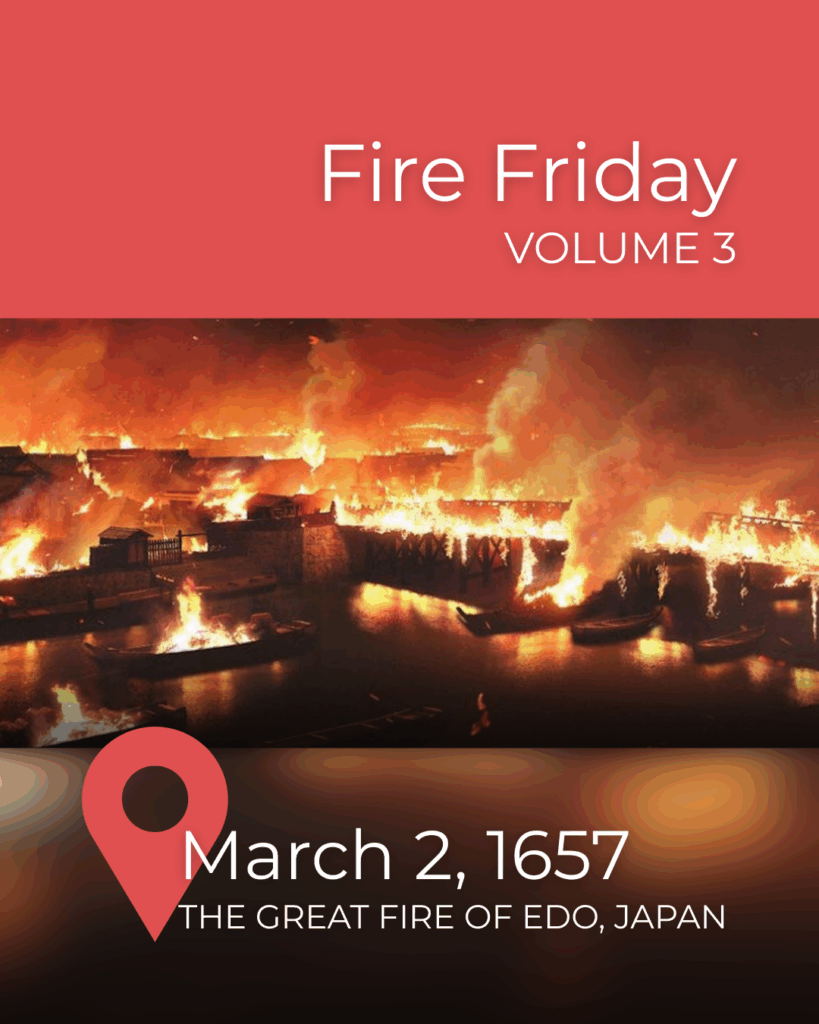
Personal space represents more than a social preference. In crowded environments—from 1657 Edo to modern data center fire suppression systems—a single spark controls the fate of the entire system.
Quick Look: The Historical Impact
Event: The Great Fire of Edo in Japan
Date: March 2, 1657
Cause: Strong winds and extreme urban density
Estimated Loss: Over one hundred thousand lives and nearly seventy percent of the city
Modern Lesson: High-density systems require localized suppression to prevent total failure
The Most Crowded City on Earth
In 1657, Edo served as the largest and most densely populated city in the world. In fact, thousands of wooden buildings stood just inches apart. According to EBSCO, the Meireki Fire started at a temple and leaped from roof to roof in seconds. Consequently, because the city lacked firebreaks, the flames consumed almost everything in their path.
The tragedy of Edo mirrors the challenges of modern AI infrastructure. Today, engineers pack massive computing power into tightly confined server racks. Similarly, like the wooden homes of Edo, these components sit in close proximity. A thermal event in one rack can quickly spread to the next. Organizations cannot risk this type of downtime. Reliability and uptime represent the core components of brand protection today.
Key Takeaways
Localized Control: High-density environments require clean agent fire suppression at the source to prevent a chain reaction.
Infrastructure Protection: Safeguarding AI and data center assets protects the brand’s reputation.
The Density Trap: Close proximity increases the speed of fire spread and requires faster response times.
Continuity of Science: Protecting modern density requires the same scientific expertise used for global standards.
Active Suppression: Passive walls do not stop fire in a high-density environment. You need active chemical intervention.
Clean Agent Fire Suppression: Why Server Racks Are the New Edo
Modern data centers achieve extreme efficiency through density. However, this density creates a pathway for fire spread. As legacy products like 3M™ Novec 1230 Fire Protection Fluid leave the market, customers face an industry-wide transition to new fire suppression products. Standard Fluids offers clarity and confidence during these shifts.
Our SF 1230™ Fire Protection Fluid serves as the firebreak for the digital age. It floods a high-density space and suppresses fire at the molecular level. It leaves no residue behind and requires no cleanup. Stopping the fire in a single rack ensures the rest of your infrastructure remains online.
The Legacy Lesson: Stopping the Chain Reaction
Fire safety in 1657 focused on destroying buildings to create gaps. Today, we use chemistry to create those gaps without destroying the assets. Clean agent fire suppression like SF 1230 fluid ensures that a localized problem does not become a global disaster for your brand. The Great Fire of Edo forced Japan to redesign its city with wider roads and fireproof plazas. In the same way, modern engineers must design for fire resilience. Clean agents like SF 1230 fluid ensure that a localized problem does not become a global disaster for your brand.
We Protect the New Standard of Science
Standard Fluids does more than just supply chemicals. We provide the continuity of science required for high-stakes environments. The industry currently faces a massive transition as legacy brands like Novec 1230 fluid exit the marketplace. This creates a trust gap because many customers do not know where to turn for reliable protection.
Think of it like a legendary Gibson guitar. You can find many instruments that look the same, but only the original master builders know the secret to the sound. Standard Fluids is led by the same team that developed and launched the original global standard molecule, FK-5-1-12. We are the master builders of this chemistry. We understand the original testing protocols and scientific nuances that ensure the fluid performs exactly when you need it most.
The Society of Fire Protection Engineers (SFPE) emphasizes that high-density storage and electronics require specialized suppression strategies. We provide the high-purity fluids and the transparency of the Certificate of Analysis needed to protect your most crowded and critical systems.
In next week’s Fire Friday, we’ll discuss the 1967 Apollo 1 Command Module Fire
Contact us today to learn how clean agent fire suppression protects your high-density infrastructure: https://standardfluids.com/contact/