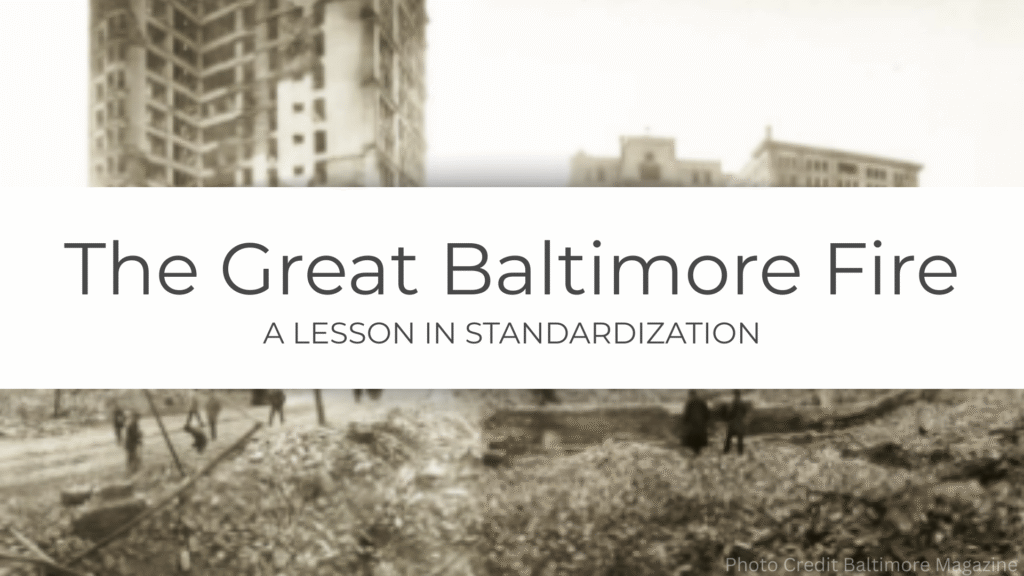
This week marks the anniversary of The Great Baltimore Fire of 1904. This disaster was a turning point in urban firefighting history. When engines from neighboring cities arrived to help, they found their hoses couldn’t connect to Baltimore’s hydrants due to varying thread sizes. This catastrophic mismatch allowed the fire to burn for over 30 hours, destroying 1,500 buildings. Today, modern NFPA standards ensure that regardless of the jurisdiction, equipment works together seamlessly. Standardization underpins the reliability of the entire system. Just as the fire service moved toward universal couplings, modern facilities must adhere to strict fire protection codes to ensure that when a crisis occurs, the hardware, and the suppression agent perform exactly as expected.
Quick Look: The Historical Impact
The Great Baltimore Fire
- Event: The Great Baltimore Fire
- Date: February 7, 1904
- The Cause: Incompatible fire hose couplings prevented mutual aid
- The Result: 1,500 buildings destroyed, 30+ hours of uncontrolled burning
Modern Lesson: Universal standards ensure fire protection systems work together across jurisdictions
Incompatibility: An Invisible Enemy
On February 7, 1904, a small fire started in the basement of the John Hurst & Company building in downtown Baltimore. What began as a manageable incident quickly escalated into one of the most devastating urban fires in American history. Despite the rapid response of local firefighters and the arrival of mutual aid from Washington, D.C., Philadelphia, New York, and other major cities, the fire consumed over 140 acres of Baltimore’s downtown business district.
The problem wasn’t a lack of manpower or courage. Firefighters from multiple jurisdictions stood ready to battle the blaze, but they faced an invisible enemy: incompatibility. Each city had developed its own fire hose coupling specifications over the years, with different thread patterns, diameters, and pitches. Baltimore’s hydrants simply wouldn’t accept hose connections from neighboring departments. Firefighters watched helplessly as buildings burned, their equipment rendered useless by a few millimeters of threading difference.The fire caused an estimated $150 million in damage, which is equivalent to billions in today’s dollars. More importantly, it exposed a critical flaw in America’s approach to fire safety. The lack of standardization had transformed what should have been a unified firefighting effort into a logistical nightmare.
The Birth of National Fire Safety Standards
The Great Baltimore Fire became a catalyst for change. In its aftermath, the National Fire Protection Association (NFPA) accelerated efforts to create universal standards for fire equipment. By 1905, the NFPA formed a committee specifically dedicated to standardizing fire hose coupling threads. This initiative eventually led to the adoption of National Standard Thread (NST) couplings, also known as National Hose Thread, which remains the standard across North America today.
But the lesson of Baltimore extended far beyond hose couplings. The disaster demonstrated that fire protection requires a systems-thinking approach where every component must work in harmony. This philosophy now underlies the comprehensive NFPA codes that govern everything from sprinkler system design to fire suppression agent specifications.
Why Standardization Matters in Modern Fire Protection
Today’s fire protection systems are remarkably sophisticated, incorporating detection, alarm, and suppression technologies that would have seemed like science fiction in 1904. However, the fundamental principle that emerged from the Baltimore fire remains unchanged: standardization saves lives and property.
Modern NFPA standards ensure that when a fire suppression system activates, every component performs its intended function. This includes the purity and performance characteristics of suppression agents like clean agents, water mist systems, and foam concentrates. Just as mismatched hose threads prevented effective firefighting in Baltimore, contaminated or substandard suppression agents can compromise system performance today.
Standard fluids used in fire protection systems must meet rigorous specifications. Whether it’s the specific gravity of foam concentrate, the cleanliness of water-based agents, or the chemical composition of clean agents, these standards guarantee consistent performance across different manufacturers and installations. When an emergency occurs, building owners and facility managers need absolute confidence that their fire protection system will work as designed.
The Ongoing Evolution of Fire Safety Standards
The NFPA continues to update and refine its standards based on new research, emerging technologies, and lessons learned from modern fire incidents. These living documents reflect our growing understanding of fire dynamics, building construction, and suppression technologies. Organizations that supply fire protection equipment and fluids must stay current with these evolving standards to ensure their products deliver reliable protection.The Great Baltimore Fire standardization effort reminds us that fire safety is a collaborative endeavor. It requires cooperation between manufacturers, regulatory bodies, fire departments, and facility managers. When everyone follows the same standards and specifications, the entire system becomes stronger and more resilient.
Standards as the Foundation of Safety
More than a century after the Great Baltimore Fire, the lesson remains clear: standardization is not merely a technical requirement but a moral imperative. The incompatible hose couplings of 1904 taught us that good intentions and brave responders aren’t enough when the fundamental systems fail to work together.
Today, adherence to NFPA standards and specifications for fire protection fluids honors the legacy of that tragic fire. By ensuring compatibility, reliability, and performance across the entire fire protection ecosystem, we create safer buildings and communities for everyone.
Contact our team to learn about clean agent fire suppression: https://standardfluids.com/contact/