
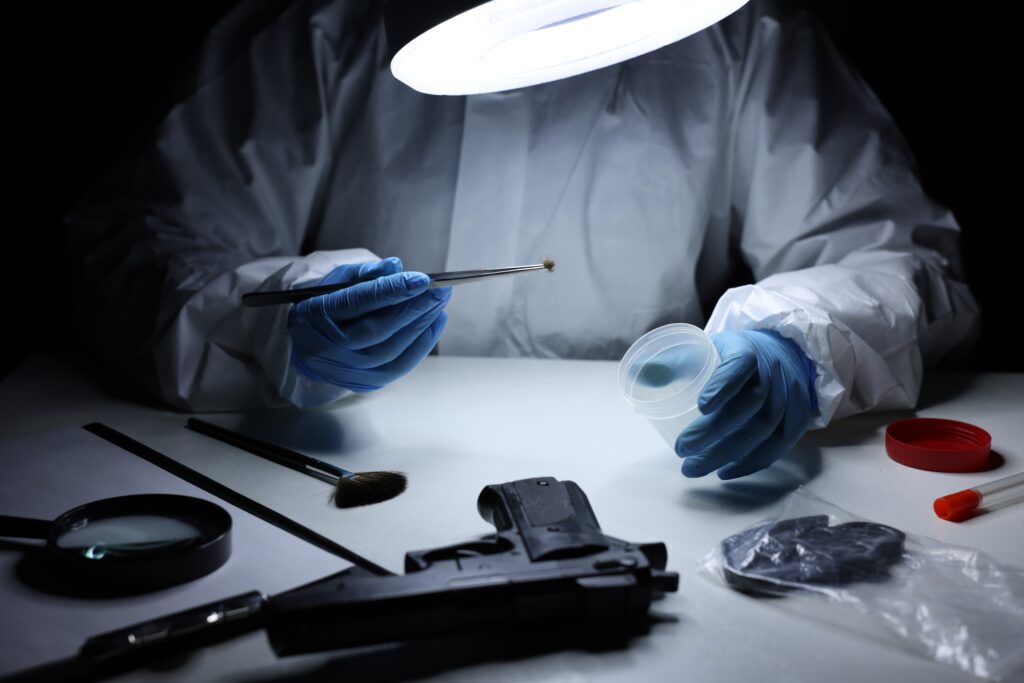
Engineered fluids are often associated with data centers and industrial cooling. However, one of their most critical applications is in forensic laboratories across the country. Episode 3 of The Splashcast explains how SF 7100™ Engineered Fluid is the sustainable solution for latent fingerprint processing. Learn how the difference between a high-purity fluid and a budget-grade substitute could mean the loss of irreplaceable evidence.
Not Just a New Alternative: The Continuation of a Legacy.
SF 7100 is backed by the same engineering pedigree that originally established the HFE standard for crime labs. Our team utilizes the proprietary quality standards and deep historical knowledge developed by the very experts who first brought this chemistry to the forensic market.
Key Takeaways
- Forensic Precision: SF 7100™️ Fluid solubilizes ninhydrin to develop fingerprints on porous surfaces like paper, cardboard, and checks where traditional dusting methods fail.
- Why Purity is Paramount: Impurities in lower-grade fluids can compromise forensic evidence or damage the integrity of documents being processed.
- Safe Application: Low toxicity and non-flammability allow crime labs to perform evidence processing safely in common workspaces without aggressive safety protocols.
Filling the Gap Left by Freon 113
For decades, forensic teams relied on Freon 113 for evidence processing, but the phase-out of ozone-depleting substances left a critical gap in the industry. SF 7100™️ Fluid provides the sustainable standard for this delicate work.
While traditional fingerprinting methods like dusting work well on non-porous surfaces like glass or metal, they are often ineffective on porous materials like checks, cardboard, or paper. To solve this, SF 7100™️ Fluid provides crime labs with the proven alternative they need. This product is a carrier solvent for ninhydrin, a compound that reacts with the amino acids and proteins left behind in a fingerprint. This reaction reveals purple-colored prints on materials that would otherwise yield no evidence. It does all this while evaporating quickly to leave the original document unharmed.
Understanding Porous vs. Non-Porous Surfaces
The challenge with porous materials lies in their structure. Unlike smooth surfaces such as glass or metal where fingerprint oils remain on the surface, porous materials like paper and cardboard absorb these oils into their fibers. Traditional fingerprint powder simply sits on top of the surface and cannot reach the absorbed oils deep within the material’s structure. This is where chemical development becomes essential. SF 7100™️ Fluid acts as the delivery mechanism, carrying ninhydrin deep into the paper fibers where it can react with the amino acids left behind by human touch. This chemical process has been the gold standard in forensic science for decades, but it requires a carrier solvent that won’t damage the evidence itself.
The Chemistry Behind Evidence Processing
As our Global Director, Steve Pignato explains, the phase-out of Freon 113 created a significant gap in forensic capabilities. Crime labs needed a solvent that could effectively carry ninhydrin without damaging sensitive documents or compromising the evidence chain.
SF 7100™️ Fluid emerged as the superior alternative. Its unique properties of high purity, low toxicity, and complete evaporation make it ideal for forensic applications where evidence integrity is non-negotiable. SF 7100™️ Fluid offers the reliability crime labs require to keep investigations moving forward without compromising environmental safety or evidence quality.
The key advantage lies in SF 7100™️ Fluid’s ability to dissolve ninhydrin completely and deliver it uniformly to porous surfaces. The fluid evaporates quickly due to its low boiling point. Because of that, only the ninhydrin remains to react with fingerprint residues. There are no impurities left behind that could interfere with evidence or contaminate the chain of custody.
This consistency matters, especially in high-stakes investigations where evidence may be decades old or has been stored in less-than-ideal conditions. Historical cold cases often rely on re-examining old evidence with modern techniques. SF 7100™️ Fluid’s stability ensures that documents from the 1970s can be processed with the same reliability as fresh evidence. The fluid’s chemical inertness means it won’t react with aged paper, deteriorated inks, or environmental contaminants that may have accumulated over time.
Because our team includes the original innovators of this technology, we maintain a thorough archive of product performance data and production records. This allows us to ensure that SF 7100™️ Fluid meets the exact purity requirements that forensic technicians have validated their protocols around for decades.
Safety Profile for Sensitive Work
A critical advantage of using SF 7100™️ Fluid in forensic environments is its safety profile. Because the fluid has very low toxicity and is non-flammable, it does not require the same aggressive safety protocols as older solvents like Freon 113 or other alternatives. This allows forensic technicians to work with precision and perform detailed evidence processing that would be dangerous or impractical with harsher chemicals.
SF 7100™️ Fluid is a safe and reliable choice for use on laboratory benchtops. This is in contrast to solvents that require fume hood containment. Crime labs are able to process more evidence efficiently and maintain the highest safety standards for their personnel while they do it. The practical implications of this safety profile extend beyond just technician health. Many smaller crime labs operate in shared facilities or municipal buildings where ventilation systems aren’t designed for hazardous chemical handling. With SF 7100™️ Fluid, these facilities can perform sophisticated forensic work without the need for expensive infrastructure upgrades like dedicated fume hoods or specialized HVAC systems.
Why Purity Makes the Difference
In forensic work, contamination isn’t just an inconvenience. It can render evidence inadmissible or destroy an irreplaceable piece of a criminal investigation.
Lower-grade fluids or budget alternatives may contain impurities that:
- Leave residues on processed documents
- React with document adhesives or inks
- Interfere with the ninhydrin reaction
- Compromise the visual clarity of developed prints
Therefore, using contaminated or impure solvents can have severe consequences.
SF 7100™️ Fluid’s high purity ensures that crime labs get consistent, reliable results every time. The fluid’s clean evaporation profile means forensic technicians can trust that what they’re seeing is the evidence itself and not artifacts from the processing fluid. We use the same rigorous validation protocols and specialized test methods used in the original development of the legacy 3M products. This ensures that every batch of SF 7100™️ Fluid provides the reliable, artifact-free results your investigation requires. This applies whether you are processing a fresh check or a fifty-year-old cold case document.
Applications in Modern Crime Labs
SF 7100™️ Fluid supports the latent fingerprint examination process by enabling effective ninhydrin delivery on porous evidence. SF 7100™️ Fluid is the crime lab solution used to process evidence like:
- Financial documents: Checks, receipts, and banking records
- Correspondence: Letters, envelopes, and notes
- Cardboard and packaging materials: Boxes and shipping materials that may contain suspect or victim prints
- Porous paper evidence: Documents where traditional methods would fail
Beyond these common applications, SF 7100™️ Fluid provides value in specialized forensic scenarios. Arson investigations often involve processing charred documents where traditional methods would cause further damage. White-collar crime investigations may require processing thousands of financial documents where speed and non-destructive testing are paramount. Even questioned document examination can benefit from SF 7100™️ Fluid’s ability to reveal fingerprints without altering inks or affecting subsequent handwriting analysis.
In addition, crime labs operating in humid tropical climates or arid desert environments face different challenges with evidence preservation. SF 7100™️ Fluid’s consistent performance across temperature ranges and humidity levels makes it reliable regardless of geographic location or storage conditions.
The fluid’s versatility and safety profile make it an essential tool for crime labs. Specifically, work where fingerprint evidence on porous surfaces could be the key to identification and prosecution.
Learn how SF 7100™️ Fluid can support your forensic laboratory: Contact our team today or explore the full technical specifications.
__________________________________________________________________