
Skip to content

Clean Agent Fire Suppression Fluids

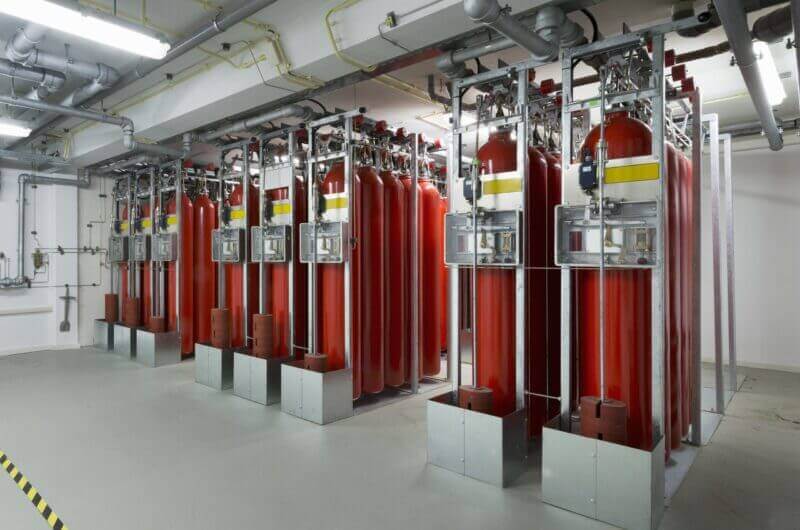
When water, residue, or oxygen displacement would compound the damage of a fire, clean agent suppression fluids are the specification. Standard Fluids supplies FK-5-1-12 fire protection fluid from the scientists and engineers who invented and patented the molecule at 3M™.

A Cleaner Fire Suppression Solution

Clean agent fire suppression is a total flooding approach that extinguishes fires using suppressants that leave no residue, require no cleanup, and do not displace the oxygen personnel need to evacuate safely. They are specified for environments where water, dry chemical, or CO₂ would damage the assets being protected or create hazards for people in the space.

FK-5-1-12 (dodecafluoro-2-methylpentan-3-one, CAS 756-13-8) is the most widely specified clean agent under NFPA 2001, carrying the highest margin of human safety of any listed agent, a GWP below 1, and zero ozone depletion potential.

Clean Agent Fire Suppression Fluid Applications

Protect active electronics, irreplaceable assets, continuous staffing, or processes that cannot tolerate conventional suppression with clean agent fire suppression fluids.

Data Centers

Active systems require a suppressant that extinguishes fires without taking hardware offline or creating post-discharge downtime.

Aviation

Sealed cargo, APU compartments, and ground equipment operate in confined spaces where rapid deployment and strict weight limits make clean agent the only viable suppression option.
Telecommunications

Equipment rooms and network switching centers require continuous protection to keep active infrastructure online through a suppression event.

Oil & Gas

Offshore platforms and compressor enclosures require immediate crew re-entry after suppression, with no decontamination steps or evacuation windows.

Medical Facilities

Clean rooms, MRI suites, and laboratory spaces require an occupied-space-rated suppressant that leaves no water or chemical residue.

Marine

Engine rooms and electrical compartments on commercial and military vessels require a non-corrosive agent that performs in enclosed spaces and ships by air for urgent offshore resupply.

Archives & Museums

Sensitive documents, film, and cultural artifacts require a waterless, residue-free agent that protects collections from the suppressant as well as the fire.
Frequently Asked Questions About Clean Agent Fire Suppression Fluids

A clean agent is a fire suppressant that leaves no residue after discharge and requires no post-event cleanup. The term covers gaseous and certain liquid agents that evaporate completely when deployed, leaving equipment, documents, and sensitive materials undamaged by the suppression itself.

Clean agents extinguish fires by absorbing heat at the molecular level rather than displacing oxygen or applying water. The agent discharges as a gas, reaches extinguishing concentration rapidly, and evaporates completely after discharge, leaving no residue, no water damage, and no equipment loss from the suppression event itself.

FK-5-1-12 is the formal chemical designation for the fluoroketone compound at the core of clean agent fire suppression systems designed around 3M™ Novec™ 1230, registered under CAS number 756-13-8. Of all clean agents listed in NFPA 2001, FK-5-1-12 provides the widest margin of human safety at design concentration, has a GWP below 1, and has zero ozone depletion potential.

Yes. FK-5-1-12 carries EPA SNAP approval for use in occupied spaces and provides the highest margin of human safety among clean agents listed in NFPA 2001. At design concentration, the agent extinguishes fires while remaining within the safety limits for personnel who remain in or evacuate through the protected space during discharge.

CO₂ suppresses fires by displacing oxygen, creating asphyxiation risk in occupied spaces. Aerosols release microscopic potassium particles to attack the fire physically and chemically.  These particles leave behind salt residue on surfaces, and can irritate the eyes, throat, and lungs of human occupants.  Water mist can damage electronics and sensitive materials. Clean agents like FK-5-1-12 extinguish fires by absorbing heat without displacing oxygen or leaving residue, making them the specification for occupied, mission-critical environments.

Clean agent systems in the US are governed by NFPA 2001, and internationally by ISO 14520. Systems must be designed, installed, and maintained to those standards. FK-5-1-12 carries EPA SNAP approval for use in occupied spaces and holds active UL and FM listings.

3M™ exited the fluorochemical market due to legal and regulatory pressure surrounding PFAS as a class. The products themselves were not the issue. Novec™ 1230 remains an approved clean agent under NFPA 2001, FM and UL listings remain active, and the molecule is still in production. Standard Fluids was built to fill the supply gap by the team that built the product in the first place.

By chemical definition, yes. Fluorinated compounds contain carbon-fluorine bonds, which is the basis for the PFAS classification. The PFAS compounds driving most regulatory action, PFOS and PFOA, bioaccumulate in tissue and persist in groundwater for decades. However, fluoroketones like FK-5-1-12 break down in the atmosphere under UV light rather than accumulate, which is why FK-5-1-12 carries a GWP below 1 despite the shared classification. Learn more about PFAS classification and regulation here.

Long-chain PFAS compounds such as PFOS and PFOA are built around fully fluorinated carbon chains with no reactive functional groups, which is what makes them persist in biological tissue and the environment for decades.

Fluoroketones contain a carbon-oxygen double bond that creates a reactive site, allowing the molecule to break down in the atmosphere under UV radiation. That structural difference produces a low GWP and means fluoroketones do not bioaccumulate, despite the shared PFAS classification.

The New Standard in Clean Agent Fire Suppression

SF 1230™ is Standard Fluids’ FK-5-1-12 fire protection fluid, produced to meet or exceed the purity of the original 3M™ Novec™ 1230 specification. It carries UL and FM listings, complieswith NFPA 2001 and ISO 14520, and ships with a batch-specific CoA and a 20-year SF StratosClear Warranty on every order.

Talk to Our Fire Suppression Team

The right clean agent starts with the right source. Contact our team, and we’ll confirm the best fit for your application, backed by the documentation your process requires.